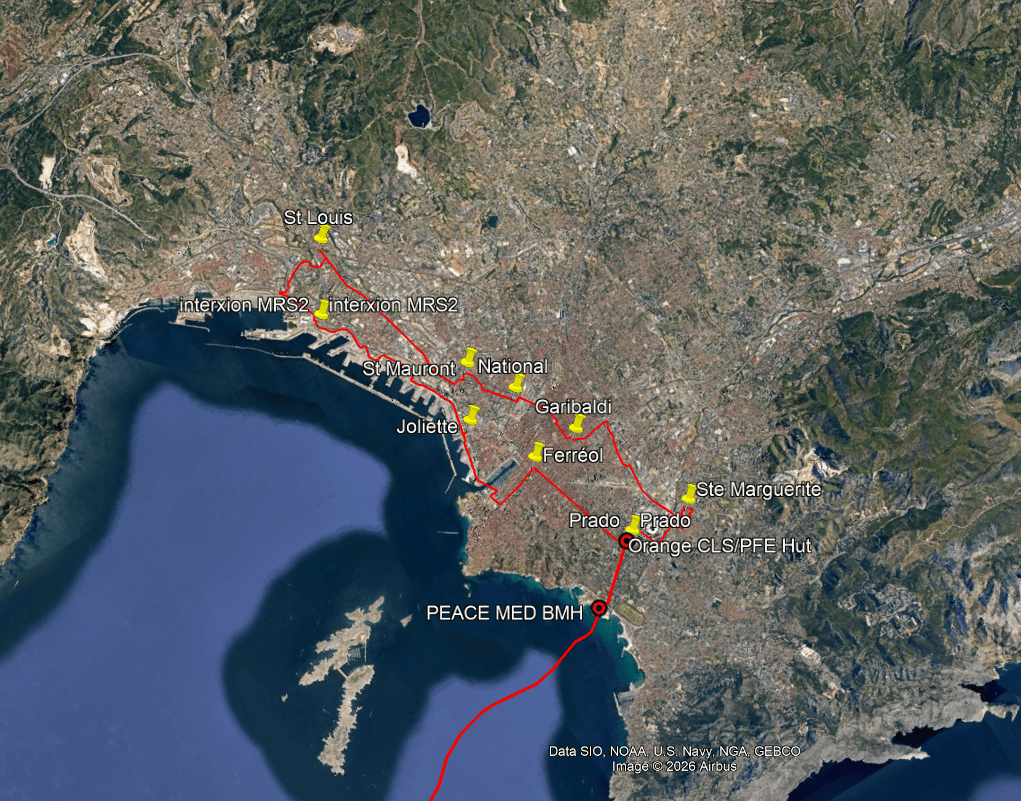
This is the Peace cable’s Marseille backhaul. It illustrates standard landing architecture as well as good network design. First of all, the cable comes ashore outside Marseille Port’s own cable landing facilities for the sake of physical diversity and resilience. Always put some distance between a cable and others if possible. This increases the cable’s value and demand for its capacity because diversity means adding it to the network portfolio improves its resilience. It is analogous to the role of diversification in a financial portfolio.
Like all other subsea cables, Peace terminates in a beach manhole where it was spliced to a terrestrial fiber cable that also contains a power conductor just like the subsea cable. Then the terrestrial fiber goes to an Orange ‘CLS’, really just a power feed hut. From there the cable becomes part of a fully diverse fiber ring that includes dual entrances into MRS2 where most of the cable’s SLTEs are kept. Most likely this fiber ring has automatic optical protection. So traffic will switch from one side of the ring to the other. The other possibility is that it is sending traffic down both sides of the ring.


Leave a Reply