Iceland’s New Audur Subsea Cable
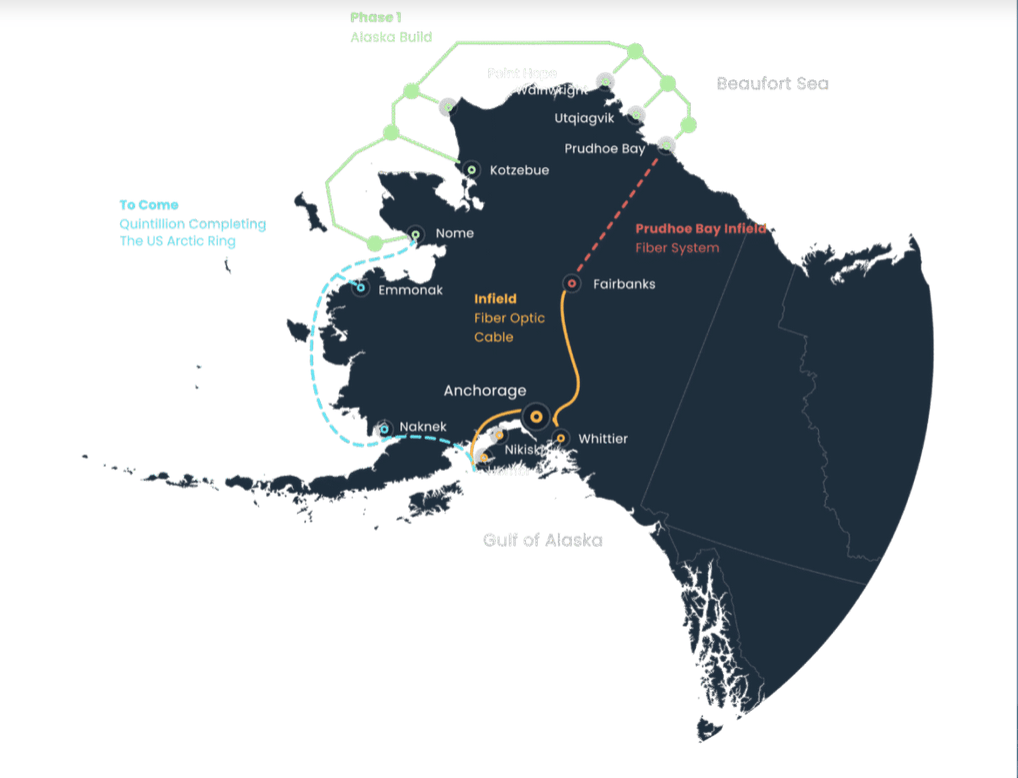
Quintillion was really formed to build a subsea cable from Japan to Europe via the North Pole. It acquired the assets, mostly human capital and preliminary research, of Arctic Fiber in 2016, and as a first step deployed a North Alaskan subsea cable serving coastal communities plus some terrestrial fibre. See the map below on the left.
No expense was spared protecting it from the harsh environment. Quintillion was buried 3.5 to 4.5 meters deep, probably a record, and for landings a bore pipe was deployed. Nonetheless, it was an ultra-high risk project. Icebergs gouge the sea floor as they float. It is called ice scouring. They carve trenches as deep as 15 meters into the sea floor. The fact is that there is no viable protection against them. Moreover, there were no icebreaker cable ships to fix the cable in case of outages. This meant that outages during autumn, winter or spring could not be fixed until late summer.
As an example, Quintillion’s most recent outage began in January 2023 and the repair was only completed on September 15, 2023. Without an icebreaker, any repair must wait until dangerous ice floes disperse sufficiently, usually, in late August or early September. Long outages like this put a subsea cable like Quintillion on financial life support. Revenues dry up, but maintenance contracts still need to be paid as well as staff, rent, power, and vendor financing.
GCS, an Alaskan carrier, bought Quintillion for an enterprise value of $325 million. But enterprise value is simply sum of Quintillion’s debt and equity. It does not mean the owners got $325 million. You need to subtract Quintillion’s short and long term debt as well as payables to get the implied equity value. A good guess that the equity value was as little as $50 million. In other words, this was a distressed asset sale and the enterprise value figure was used to disguise the transaction’s true nature.
As someone who does due diligence for financing entities, I can clearly say that Quintillion’s initial financing was a failure of proper due diligence. It was never viable and should not have been built. Only if one could secure an icebreaker cable ship (which probably does not exist today) for a reasonable cost would the project made sense. I would have told the cable’s financiers, the Cooper Investment Fund, that Quintillion was a dog. But financiers are generally ultra-confident alpha males, which leads them to make big mistakes. Whether it is Musk alienating the generally politically liberal Tesla customers with his right wing politics or Morgan Stanley financing Pet.com, arrogance leads to blindness and it is the kiss of financial death.
Audur falls into the monster capacity cable category. Sixteen fibre pairs can easily achieve 320 Tbps with 24 fibre pairs almost reaching a half petabit per second. What is really striking about this is Iceland’s population, which although rapidly increasing due to immigration, is just shy of 400K. Undoubtedly, this reflects Farice’s bullish assessment of data center demand driven by cheap hydro power and modest cooling needs. Although Iceland is often associated with geothermal, hydro is the dominant source of electricity. In fact, the country has three aluminum smelting plants all built there to take advantage of the cheap power. Iceland should not be lumped in the same category as relatively poor Greenland. Iceland’s per capita real GDP is 15th in the global ranking. The country is highly prosperous. It is a tribute to a highly educated and skilled population.


Leave a Reply